We write to the people who make the decisions.

Our policy team looks into problems we see in Hong Kong and writes recommendations to the government. Everything here has actually been submitted, and there's more on the way.

So far

~20
recommendations sent to the government each year
HK$50M
allocated to AI for All in the 2026–27 Budget, the kind of inclusive AI programme we'd been arguing for. What we sent, and what we can claim
2024–
responses to every Policy Address and Budget consultation since 2024
2026–2030
our submission to the First Five-Year Plan for Economic and Social Development, in progress

Our main project · AI for All, 2024–2026

From what we saw in class to the 2026–27 Budget.

In February 2026, the Hong Kong Budget set aside HK$50 million for an inclusive AI programme. Over two years it aims to reach about 50,000 people through more than 200 courses, seminars and competitions. It's run by Cyberport, HKSTP and the Hong Kong Productivity Council, and Cyberport's part is aimed at students, parents, older people and underprivileged communities.

HK$50 million
allocated in the 2026–27 Budget
50,000
people it aims to reach
200+
courses, seminars and competitions
2 years
to deliver them
  1. What we noticed

    We were teaching in schools that had no AI lessons and no money to start any, and we saw the same thing in every classroom. The children picked things up fast. What they were missing was access. The families most likely to be left behind by AI were also the ones that programmes run through schools and employers were least likely to reach.

    In class, where most of our proposals start.

    the next year

  2. What we did

    We turned what we'd seen into a written argument. We interviewed the members who teach, looked at what public support already existed and who it was missing, and wrote a proposal with the case for, the case against and our recommendation. We sent it to the Policy Address consultation in August 2025, then made the same case again in our Budget submission.

    six months later

  3. Feb–Jun 2026

    What changed

    HK$50 million

    The 2026–27 Budget allocated HK$50 million to AI for All, and the programme launched in June 2026. The argument we'd been making was echoed in how it was designed: Cyberport's part is aimed at students, parents, older people and underprivileged communities, the same groups we said a general push on AI skills would reach last. The sources are listed below, so you can check this yourself.

What we can claim: we recommended it, and the Budget went that way. AI for All is a government programme, paid for and run by public bodies. We didn't fund it and we don't run it.

Why we asked for it
We teach AI to primary school children in schools with no AI lessons and no budget for them. The children were interested and quick to learn. What they lacked was access. So every year our submissions made the same point: if AI training only comes through schools and employers, it reaches families who already have it and misses the ones who don't. Public money should reach the people at the back of the queue first.
What we submitted
In August 2025 we made this argument to the Policy Address consultation, and again in our Budget submission. We asked the government to fund AI learning directly for the people least likely to come across it, such as children in under-resourced schools, their parents and older residents, instead of going through organisations that would reach them last. We asked for money set aside for that group in particular, not a general promise about AI skills.
What it means, and what it doesn't
This is a start, not the finish. The government has called HK$50 million an initial amount, and the 50,000-participant target a baseline based on current resources. Officials have said more money could follow if there's demand. Fifty thousand people is a small share of Hong Kong. Our view for the next round is that the demand is there and the funding should follow, and we plan to say so in our submission to the First Five-Year Plan.

Why it matters

Access is only half the problem. In 2019, 94% of Hong Kong households had internet access, but only 71% of households earning under HK$10,000 a month did. And even with a device, a child with nobody to show them how to use AI well can end up leaning on it instead of learning from it. That second gap is what our Think First proposal is about.

Households with internet access at home, 2019
All Hong Kong households
94%
Households earning under HK$10,000 a month
71%

Source: Legislative Council Research Office.

What we're watching next

  • Who it reaches. Whether the places really go to students, parents and older people from low-income households, and whether the government publishes who took part.
  • How it's taught. Whether the courses for children teach them to think with AI, not just to use it.
  • Whether it grows. HK$50 million and 50,000 people is a start. We'll keep arguing that the funding should follow the demand.
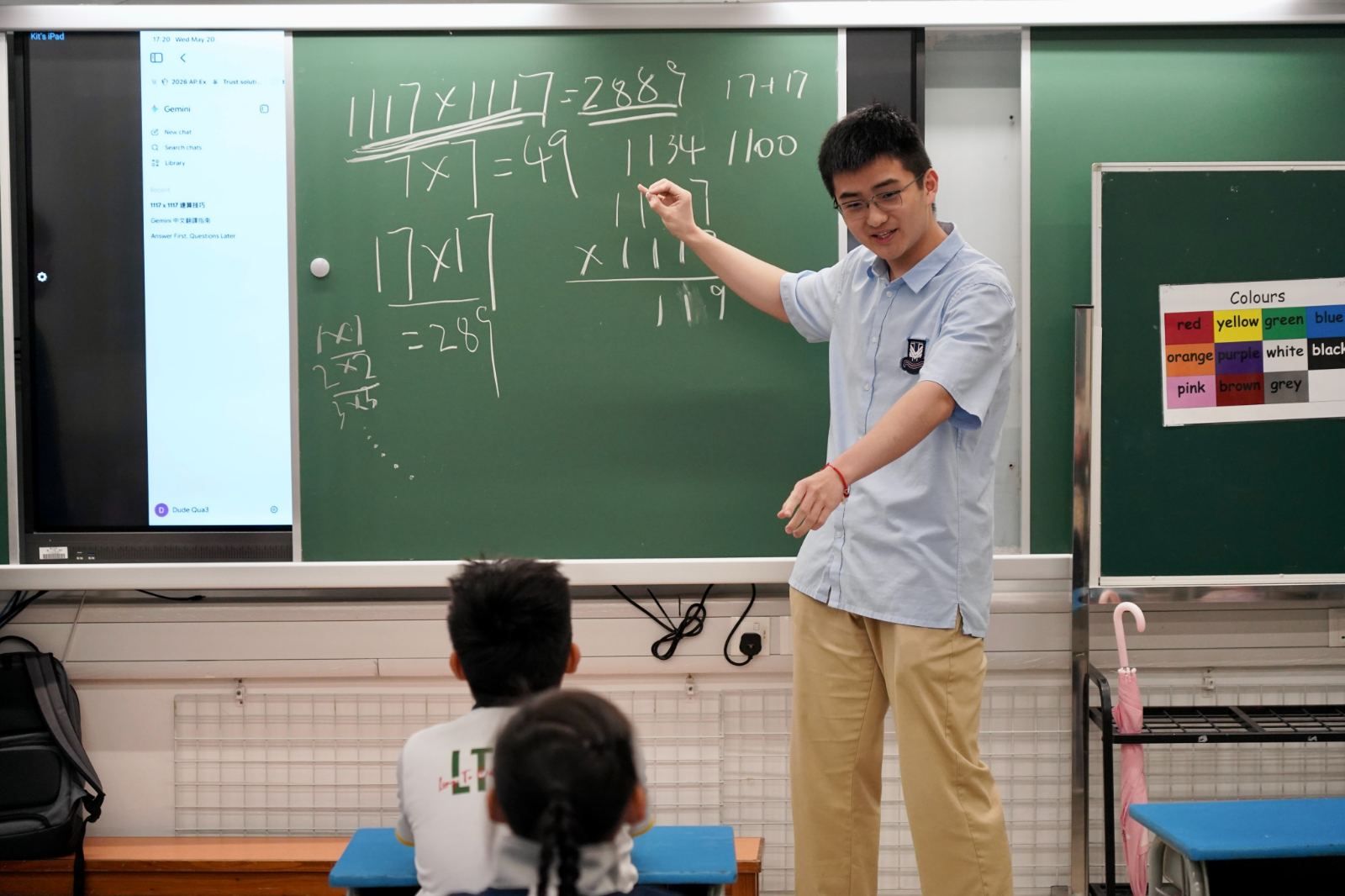
A tutor works through a mental-arithmetic shortcut for 1117 × 1117 on the chalkboard.
A maths session at Ho Man Tin Ling To Catholic School. Most of our proposals start in a classroom like this one.

Everything we've sent the government.

Each submission holds several recommendations: about twenty a year in total.

Our submissions to the Hong Kong government, newest first
DateSubmissionAskWhere it stands
First Five-Year Plan (2026–2030)AI funding should go where the need is.In progress
2025–262026–27 Budget consultationThe same case: fund AI learning for the people least likely to get it.Reflected in the 2026–27 Budget
Think First: closing the AI gap for young childrenA method for how children use AI, training for teachers, and a HK$54 million pilot in the primary schools serving the lowest-income families.Teaching guide and teacher training in the June 2026 blueprint
2025 Policy Address consultationFund AI learning directly for the people least likely to get it.Reflected in the 2026–27 Budget
Retrain Before RedundancyPay at-risk workers to retrain before they lose their jobs: up to about HK$240 million over three years.Submitted
2024–252025–26 Budget consultationSubmitted
2024 Policy Address consultationSubmitted

More to be added to the website.

How we write a proposal

Every proposal argues against itself first.

  1. Talking to the people it affects

    Every proposal starts with the people a policy touches. Our topics come from what our members have actually seen, not from the news, and we interview teachers, parents, workers and frontline staff as well as our own tutors: what happened, who it affected, and whether it happens once or every week. If only one person has noticed a problem, we look for more evidence before turning it into a proposal.

  2. Research

    Next we check whether it's really a policy problem. What does the government already fund in this area? Who does that help, and who does it miss? What have similar places tried, and what did it cost? If an existing policy already covers it, we say so and drop it. This step is meant to rule proposals out, not to justify them.

  3. Writing and submitting

    A member writes the proposal in the three-part format below, and we make the case against as strong as we honestly can. If it wins, the proposal doesn't go out. The ones that survive go to whichever consultation is open, whether that's the Policy Address, the Budget or a bureau's own call for views, with a recommendation clear enough to act on.

Every proposal follows the same three-part format:

The format every proposal follows

How we structure every AFG submission

The case for
The strongest arguments in favour: what the policy would achieve, who it would help, and the evidence for it.
The case against
The honest arguments against: the costs, the risks and who would bear them. If these win, we don't submit.
What we recommend
What we're asking the government to do, in plain words, once both sides have been heard, with what it would cost and how we'd know whether it worked.

The rule. If the case against turns out to be stronger, the proposal doesn't go out.

Two of our proposals

Two examples of what we send to the government, newest first. Each one makes the case for and against, then recommends something with a cost and a way to measure whether it worked.

· Education & inequality · Teaching guide and teacher training in the June 2026 blueprint

Think First: Closing the AI Gap for Young Children Without Outsourcing Their Thinking

Hong Kong is about to put AI into every primary school. Used well, it can give every child the kind of patient tutor only better-off families can pay for. Used badly, it teaches children to hand their thinking to a machine before they've learned to think for themselves. We propose a "Think First" approach, and a HK$54 million pilot in the primary schools serving Hong Kong's lowest-income families.

What we noticed
Hong Kong is about to put AI into every primary school. Used badly, it teaches children to hand their thinking to a machine before they've learned to think for themselves. Our tutors were already seeing it in class.
What we did
We proposed a "Think First" approach, the method our tutors use every week, and a HK$54 million pilot in the primary schools serving Hong Kong's lowest-income families.
What changed
In June 2026 the Education Bureau published its Blueprint for Digital Education Development. When we wrote, nothing told a primary teacher how a child should use AI. The blueprint now brings in an AI Literacy Learning Framework and a guide to using AI in teaching, and makes at least 30 hours of digital education training compulsory for teachers in every three-year cycle. We asked for a method and for trained teachers, and both are now in place. Next is the pilot in the lowest-income schools, which we're asking for again in our coming submissions.
Read the full proposal

· Labour economics · Submitted

Retrain Before Redundancy: Preventing AI-Driven Structural Unemployment in Hong Kong

Hong Kong is short of workers just as AI looks set to make many routine office jobs unnecessary. That's how structural unemployment starts: the jobs exist, but the people who lose theirs can't fill them. Hong Kong mostly pays people to retrain after they lose their job. We propose paying at-risk workers to retrain before it happens, steering them towards sectors that are short of staff, and rewarding employers who retrain people instead of letting them go, for up to about HK$240 million over three years.

What we noticed
Hong Kong is short of workers just as AI looks set to make many routine office jobs unnecessary. Hong Kong mostly pays people to retrain after they lose their job.
What we did
We proposed paying at-risk workers to retrain before redundancy, steering them towards sectors short of staff, and rewarding employers who retrain people instead of letting them go: up to about HK$240 million over three years.
What's changed so far
The 2026–27 Budget announced that the Employees Retraining Board will be upgraded as Upskill Hong Kong, with skills-based courses that include AI applications. In September 2026 the government's own manpower update projected a surplus of 25,000 to 30,000 clerical workers by 2028 as companies use more AI, the risk our proposal was written about. Paying those workers to retrain before they are made redundant is the part still to come.
Read the full proposal